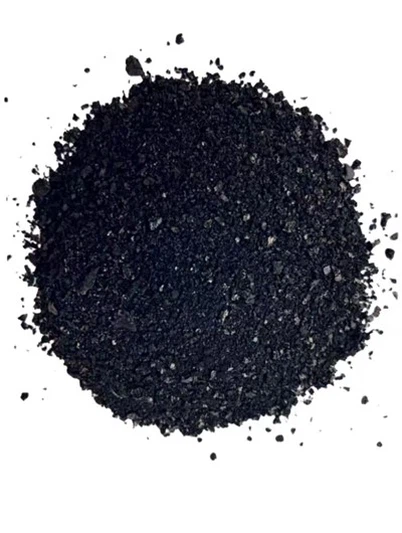
Solutions To Color Shade Deviation in Sulfur Black Dyeing
Jan 26, 2026
Leave a message
Color shade deviation in sulfur black dyeing is mainly caused by three factors: raw material quality fluctuation, process parameter out-of-control, and equipment status abnormality. It needs to be solved systematically in the steps of "inspection - adjustment - verification". The specific solutions are as follows:
I. Source Control: Inspection and Optimization of Raw Material Factors
The root cause of color shade deviation often lies in raw materials. Three types of core materials need to be focused on:
1. Sulfur black dye itself
- Natural color shade differences exist among different grades (3B/4B/3BR/2RB) of sulfur black. It is necessary to confirm whether the dye batches are consistent, and avoid mixing dyes from different manufacturers and batches.
- Check the fineness and moisture content of the dye: insufficient fineness can lead to uneven dissolution, and excessive moisture content will reduce the concentration of active ingredients. Ensure that the dye fineness is ≥ 200 mesh and the moisture content is ≤ 5%.
- Solutions: Use dyes from the same manufacturer and batch for dyeing in the same batch; sieve the dyes before use to remove caking impurities; follow the principle of "preparing and using immediately" to avoid oxidation of dye solution after long-term storage.
2. Quality of sodium sulfide (reducing agent)
- The effective sulfur content of sodium sulfide directly affects the reduction degree of dyes. Too low content will lead to insufficient reduction of dyes, resulting in lighter and reddish color shade; too high content will easily cause over-reduction, leading to darker and greener color shade.
- Solutions: Select industrial-grade sodium sulfide (effective sulfur content ≥ 60%), and test the content before use; accurately proportion according to the dye dosage, generally the mass ratio of sodium sulfide to dye is 1:1 ~ 1.5:1.
3. Quality of dyeing water
- Hard water (high calcium and magnesium ion content) will combine with dyes to form precipitates, resulting in grayish and dark color shade; iron ions in water will make the color shade reddish-brown.
- Solutions: The dyeing water should be softened, and the hardness should be controlled below 50mg/L; if necessary, add chelating agents (such as EDTA) with a dosage of 0.5 ~ 1g/L to eliminate the interference of metal ions.
Process Control: Adjustment and Optimization of Process Parameters
Process parameter fluctuation is the main inducement of color shade deviation. Five key links need to be focused on:
1. Dye reduction process
- Insufficient reduction temperature and time: incomplete dye reduction, resulting in lighter color shade and color streaks; excessive reduction temperature (> 90℃) and too long time: dye hydrolysis, resulting in darker color shade.
- Solutions: Control the sulfur black reduction temperature at 60 ~ 80℃ and the reduction time at 30 ~ 40min; stir evenly during reduction with the rotation speed controlled at 50 ~ 80r/min to avoid uneven local reduction.
2. Dyeing temperature and heating rate
- Too low dyeing temperature (< 50℃): slow dye uptake rate, resulting in lighter color shade; too high temperature (> 90℃): fast dye uptake, easy to cause color streaks and color shade deviation.
- Too fast heating rate: uneven dye uptake inside and outside the fiber, inconsistent color shade; too slow rate: low production efficiency, lighter color shade.
- Solutions: Control the dyeing temperature at 60 ~ 80℃ and the heating rate at 1 ~ 2℃/min; adopt the "stepwise heating" method to avoid sudden temperature rise and fall.
3. Bath ratio control
- Too large bath ratio: diluted dye concentration, resulting in lighter color shade; too small bath ratio: uneven contact between dye and fiber, causing color streaks and color shade deviation.
- Solutions: Adjust the bath ratio according to the fabric type, with the bath ratio of woven fabrics being 1:10 ~ 1:15 and that of knitted fabrics being 1:15 ~ 1:20; ensure good bath solution circulation during dyeing to avoid uneven local bath ratio.
4. Oxidation process
- Sulfur black needs oxidation fixation after dyeing. Insufficient oxidation: dyes are not fully fixed, resulting in lighter color shade and poor fastness; excessive oxidation: dye oxidation decomposition, resulting in reddish and dark color shade.
- Solutions: Adopt air oxidation or hydrogen peroxide oxidation, with air oxidation time being 15 ~ 20min; for hydrogen peroxide oxidation, the concentration of hydrogen peroxide is 0.5 ~ 1g/L, the temperature is 30 ~ 40℃, and the time is 10 ~ 15min; rinse with clean water after oxidation to avoid residual oxidant affecting the color shade.
5. Soaping and fixation treatment
- Insufficient soaping: residual floating color on the fabric surface, resulting in grayish color shade and poor fastness; too high soaping temperature (> 90℃): dye dissolution, resulting in lighter color shade.
- Solutions: Control the soaping temperature at 70 ~ 80℃, the soaping agent dosage at 1 ~ 2g/L, and the time at 15 ~ 20min; rinse with warm water after soaping, and add fixing agents (such as cationic fixing agents) with a dosage of 1 ~ 2g/L if necessary to improve the color shade stability.
Equipment Control: Inspection and Maintenance of Equipment Status
Equipment abnormalities will lead to unstable process parameters during dyeing, which in turn cause color shade deviation. Three key points need to be focused on:
1. Dyeing machine temperature control system
- Malfunction of temperature control probe: the actual temperature is inconsistent with the set temperature, leading to color shade deviation; local overheating of heating tube: local overheating of bath solution, causing color streaks.
- Solutions: Calibrate the temperature control probe regularly, with the error controlled within ±1℃; check whether the heating tube is scaled, and clean it in time to ensure uniform heating.
2. Stirring and circulation system
- Damaged stirring paddle or uneven rotation speed: uneven mixing of bath solution and uneven dye distribution; circulation pump failure: poor bath solution circulation, resulting in local dyeing differences.
- Solutions: Inspect the stirring paddle and circulation pump regularly to ensure normal operation; adjust the stirring speed according to the type of dyeing machine to avoid fabric entanglement leading to uneven stirring.
3. Fabric loading capacity
- Excessive loading capacity: fabric accumulation, uneven contact between dye and fiber, causing color streaks and color shade deviation; insufficient loading capacity: too large bath ratio, resulting in lighter color shade.
- Solutions: Operate in strict accordance with the rated loading capacity of the dyeing machine, with the loading capacity of woven fabrics controlled at 70% ~ 80% of the equipment capacity and that of knitted fabrics controlled at 60% ~ 70%.
Emergency Adjustment: Remedial Measures for Existing Color Shade Deviation
- Reddish color shade: Appropriately add sodium sulfide (0.2 ~ 0.5g/L), heat up to 70℃ for reduction for 10min, and then perform oxidation fixation; or add a small amount of navy blue dye for fine adjustment.
- Greenish color shade: Reduce the dosage of sodium sulfide, extend the oxidation time by 5 ~ 10min; or add a small amount of red light dye for correction.
- Lighter color shade: Add 10% ~ 20% of sulfur black dye, and re-reduce, dye and oxidize; note that the supplementary dye should be fully dissolved to avoid color streaks.
- Grayish color shade: Strengthen soaping to remove floating color; or treat with diluted acetic acid (0.5 ~ 1g/L) to improve the color shade vividness.
Preventive Measures: Long-term Mechanism to Avoid Color Shade Deviation
- Establish a raw material inspection system, test the key indicators of each batch of dyes and sodium sulfide, and use them only after passing the inspection.
- Formulate standardized dyeing process cards, clarify the parameters of each link, and prohibit arbitrary adjustment.
- Maintain the dyeing equipment regularly to ensure the stable operation of the temperature control, stirring and circulation systems.
- Conduct a small-scale test before formal dyeing, and start large-scale production only after confirming that the color shade meets the requirements.