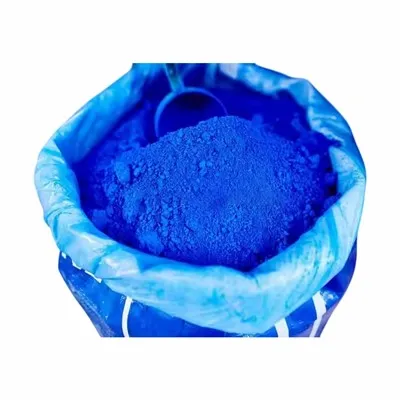
How to determine the concentration of Vat Blue Vb in a solution?
Leave a message

Determining the concentration of Vat Blue Vb in a solution is a crucial aspect, especially for those in the dye industry. As a supplier of Vat Blue Vb, I understand the significance of accurate concentration measurement. It not only ensures the quality of the final product but also helps in cost - effective production. In this blog, I will discuss several methods to determine the concentration of Vat Blue Vb in a solution.
1. Spectrophotometric Method
Spectrophotometry is one of the most widely used techniques for determining the concentration of dyes in solutions. It is based on the principle that substances absorb light at specific wavelengths. Vat Blue Vb has characteristic absorption peaks in the visible light spectrum.
First, a calibration curve needs to be established. Prepare a series of standard solutions of Vat Blue Vb with known concentrations. For example, you can prepare solutions with concentrations of 1 mg/L, 2 mg/L, 3 mg/L, 4 mg/L, and 5 mg/L. Then, use a spectrophotometer to measure the absorbance of each standard solution at the maximum absorption wavelength of Vat Blue Vb. The maximum absorption wavelength can be determined by scanning the solution in the visible range (usually from 400 - 700 nm).
Plot the absorbance values on the y - axis and the corresponding concentrations on the x - axis. A linear relationship (Beer - Lambert's Law) is usually obtained in the form of (A=\epsilon bc), where (A) is the absorbance, (\epsilon) is the molar absorptivity, (b) is the path length of the cuvette (usually 1 cm), and (c) is the concentration.
Once the calibration curve is established, measure the absorbance of the unknown Vat Blue Vb solution at the same wavelength. Then, use the calibration curve to determine the concentration of the unknown solution. This method is relatively simple, fast, and accurate, especially when the solution is relatively pure and free from interfering substances.
2. Titration Method
Titration can also be used to determine the concentration of Vat Blue Vb. Vat dyes are usually insoluble in water in their oxidized form but can be reduced to a soluble leuco form. A common titrant for Vat Blue Vb is a reducing agent such as sodium dithionite.
First, prepare a standard solution of the reducing agent with a known concentration. Take a known volume of the Vat Blue Vb solution and add a suitable indicator. The indicator should change color when all the Vat Blue Vb has been reduced.
Slowly add the reducing agent solution from a burette to the Vat Blue Vb solution until the color change of the indicator is observed. Record the volume of the reducing agent used. Based on the stoichiometry of the reaction between Vat Blue Vb and the reducing agent, the concentration of Vat Blue Vb can be calculated.
However, this method requires careful control of experimental conditions. The reaction rate may be affected by factors such as temperature, pH, and the presence of impurities. Also, the choice of indicator is crucial for accurate results.
3. High - Performance Liquid Chromatography (HPLC)
HPLC is a powerful analytical technique that can separate and quantify different components in a solution. It is particularly useful when the Vat Blue Vb solution contains other impurities or related compounds.
In HPLC, the sample is injected into a column filled with a stationary phase. A mobile phase, which is a solvent or a mixture of solvents, is pumped through the column. Different components in the sample interact differently with the stationary phase and are separated based on their chemical properties.
The separated components are then detected by a detector, such as a UV - Vis detector. Similar to the spectrophotometric method, a calibration curve needs to be established using standard solutions of Vat Blue Vb. The peak area or peak height of the Vat Blue Vb peak in the chromatogram is proportional to its concentration.
HPLC offers high sensitivity and selectivity. It can accurately determine the concentration of Vat Blue Vb even in complex mixtures. However, it requires expensive equipment and trained personnel to operate.
Factors Affecting Concentration Determination
Several factors can affect the accuracy of the concentration determination of Vat Blue Vb.
Temperature: Temperature can affect the solubility of Vat Blue Vb and the reaction rates in titration and other methods. For example, in the spectrophotometric method, changes in temperature can cause shifts in the absorption spectrum. It is recommended to perform all experiments at a constant temperature.
pH: The pH of the solution can also have a significant impact. Vat dyes are sensitive to pH changes, and the color and solubility of Vat Blue Vb may vary with different pH values. In titration, the pH can affect the reaction between the dye and the titrant. Therefore, it is necessary to control the pH of the solution during the experiment.
Impurities: The presence of impurities in the solution can interfere with the measurement. In spectrophotometry, impurities may absorb light at the same wavelength as Vat Blue Vb, leading to inaccurate absorbance values. In HPLC, impurities can co - elute with Vat Blue Vb, making it difficult to accurately quantify the dye.
Comparison with Other Vat Dyes
Vat Blue Vb is just one of the many vat dyes available in the market. Other popular vat dyes include Vat Red R, Vat Grey M, and Vat Blue Rsn. Each of these dyes has its own unique properties, absorption spectra, and reaction characteristics.
When determining the concentration of these dyes, the general principles of the methods mentioned above still apply. However, the specific experimental conditions, such as the maximum absorption wavelength in spectrophotometry or the reaction stoichiometry in titration, may vary. For example, Vat Red R may have a different maximum absorption wavelength compared to Vat Blue Vb, so the calibration curve for each dye needs to be established separately.


Importance of Accurate Concentration Determination
Accurate concentration determination of Vat Blue Vb is of great importance in the textile and dyeing industry. In textile dyeing, the concentration of the dye solution directly affects the color intensity and fastness of the dyed fabric. If the concentration is too low, the fabric may not achieve the desired color depth. On the other hand, if the concentration is too high, it may lead to uneven dyeing and increased production costs.
In addition, accurate concentration determination helps in quality control. It ensures that the Vat Blue Vb supplied meets the required standards. For suppliers like me, it is essential to provide customers with high - quality products with consistent concentrations.
Conclusion
Determining the concentration of Vat Blue Vb in a solution can be achieved through various methods, including spectrophotometry, titration, and HPLC. Each method has its own advantages and limitations, and the choice of method depends on factors such as the nature of the sample, the required accuracy, and the available equipment.
As a supplier of Vat Blue Vb, I am committed to providing high - quality products and technical support. If you are interested in purchasing Vat Blue Vb or have any questions about its concentration determination, please feel free to contact me for further discussion and negotiation.
References
- Skoog, D. A., West, D. M., Holler, F. J., & Crouch, S. R. (2013). Fundamentals of Analytical Chemistry. Cengage Learning.
- Harris, D. C. (2015). Quantitative Chemical Analysis. W. H. Freeman and Company.
- Snyder, L. R., Kirkland, J. J., & Glajch, J. L. (2010). Practical HPLC Method Development. John Wiley & Sons.