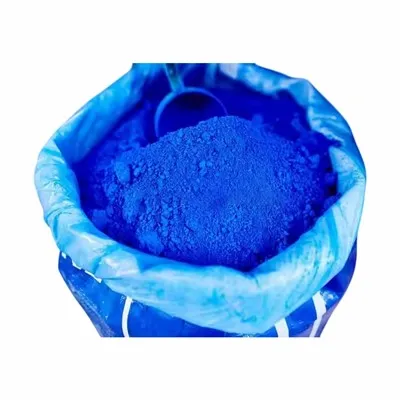
What is the chemical structure of Vat Blue Rsn?
Leave a message

Hey there! As a supplier of Vat Blue Rsn, I often get asked about its chemical structure. So, let's dive right into it and break down what makes Vat Blue Rsn tick.
First off, Vat Blue Rsn belongs to the family of vat dyes. These dyes are known for their excellent color fastness, which makes them a popular choice in the textile industry. They work in a unique way compared to other types of dyes. Vat dyes are insoluble in water in their original state, but through a chemical reduction process, they can be converted into a soluble form. This soluble form can then be absorbed by the fabric, and after oxidation, it reverts back to its insoluble state, firmly attaching to the fibers.
Now, let's talk about the chemical structure of Vat Blue Rsn itself. Vat Blue Rsn is an anthraquinone - based dye. Anthraquinone is a polycyclic aromatic hydrocarbon with a core structure consisting of three fused benzene rings with two carbonyl groups (C = O) at the 9 and 10 positions. This basic anthraquinone structure serves as the foundation for many vat dyes, including Vat Blue Rsn.
The chemical formula of Vat Blue Rsn is C28H14N2O4. In its molecular structure, there are additional functional groups attached to the anthraquinone core. These functional groups play a crucial role in determining the dye's color, solubility, and affinity for different types of fabrics. Specifically, the nitrogen - containing groups and the overall arrangement of atoms around the anthraquinone structure give Vat Blue Rsn its characteristic blue color.
One of the interesting things about the chemical structure of Vat Blue Rsn is its planarity. The molecule has a relatively flat structure, which allows it to interact well with the flat surfaces of textile fibers. This interaction is essential for the dye to be adsorbed onto the fabric effectively. When the dye is in its soluble leuco form (the reduced form), it can penetrate the fiber pores. Once it is oxidized back to its insoluble form, it gets trapped within the fiber structure, providing long - lasting color.
Compared to other vat dyes like Vat Yellow Gcn and Vat Green Ffb, Vat Blue Rsn has a distinct color due to its unique chemical structure. The different functional groups and the way they are arranged around the anthraquinone core result in different absorption spectra, which is what gives each dye its specific color. For example, Vat Yellow Gcn might have different substituents on the anthraquinone structure that absorb light in the yellow part of the visible spectrum, while Vat Green Ffb has a structure that causes it to absorb light and reflect green.
The synthesis of Vat Blue Rsn also involves precise chemical reactions to build up the complex molecular structure. Chemical engineers have to carefully control the reaction conditions, such as temperature, pressure, and the type of reagents used. Starting from simple precursors, the anthraquinone core is gradually modified to introduce the necessary functional groups to form Vat Blue Rsn.
The stability of Vat Blue Rsn's chemical structure is another important factor. It needs to be resistant to various environmental factors such as light, heat, and chemicals. This stability ensures that the color of the dyed fabric remains vibrant and does not fade easily over time. For instance, when exposed to sunlight, the chemical bonds in Vat Blue Rsn should not break easily, maintaining the integrity of the dye molecule and the color on the fabric.


In the textile industry, the knowledge of the chemical structure of Vat Blue Rsn is very useful. Textile manufacturers can use this information to optimize the dyeing process. For example, they can adjust the pH, temperature, and time of the reduction and oxidation steps based on the properties of the dye's chemical structure. This way, they can achieve better dyeing results, such as more even color distribution and higher color fastness.
As a supplier of Vat Blue Rsn, I understand the importance of providing high - quality products. The chemical purity of the Vat Blue Rsn we supply is crucial. Any impurities in the dye can affect its chemical structure and properties, leading to inconsistent dyeing results. That's why we have strict quality control measures in place to ensure that our customers get the best - quality Vat Blue Rsn.
Now, if you're in the textile business or any other industry that uses vat dyes, and you're interested in purchasing Vat Blue Rsn, we'd love to have a chat with you. We can provide you with detailed information about our product, including its chemical properties, application methods, and of course, the price. Our team of experts is always on hand to answer any questions you might have about the dyeing process or the chemical structure of Vat Blue Rsn. So, don't hesitate to reach out and start a conversation about your procurement needs.
In conclusion, the chemical structure of Vat Blue Rsn is a fascinating topic. It's the key to understanding its color, performance, and how it works in the dyeing process. Whether you're a chemist, a textile manufacturer, or just someone curious about dyes, I hope this blog has given you a better understanding of what makes Vat Blue Rsn unique.
References
- The Chemistry of Synthetic Dyes, John Wiley & Sons
- Textile Dyeing and Finishing Handbook, Woodhead Publishing