How does Acid Blue 93 react with metal ions?
Leave a message

Hey there! I'm a supplier of Acid Blue 93, and today I wanna chat about how this cool dye reacts with metal ions. Acid Blue 93 is a well - known acid dye that's used in a bunch of industries, like textiles and leather. It's got some interesting chemical properties, especially when it comes to its interaction with metal ions.
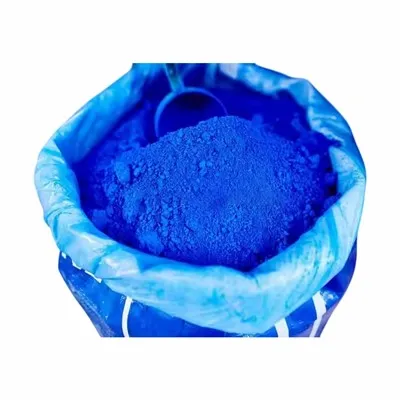
First off, let's talk a bit about what Acid Blue 93 is. It's a synthetic dye with a distinct blue color. The chemical structure of Acid Blue 93 has certain functional groups that can interact with metal ions. These functional groups act like little hooks that can grab onto metal ions in a solution.
When Acid Blue 93 meets metal ions, a chemical reaction called complexation can occur. Complexation is when a central metal ion is surrounded by other molecules or ions, called ligands. In this case, Acid Blue 93 acts as a ligand. The dye molecule has atoms with lone pairs of electrons, like nitrogen and oxygen. These lone pairs can form coordinate covalent bonds with the metal ions.
For example, when Acid Blue 93 reacts with copper ions (Cu²⁺), the nitrogen and oxygen atoms in the dye molecule donate their lone pairs of electrons to the copper ion. This forms a stable complex. The resulting complex has different properties compared to the original dye and the metal ion. It might have a different color, solubility, or stability.
The color change is one of the most noticeable effects of this reaction. The original Acid Blue 93 has its characteristic blue color, but when it forms a complex with a metal ion, the color can shift. This is because the energy levels of the electrons in the complex are different from those in the free dye. The absorption and emission of light by the complex are affected, leading to a change in color.

The stability of the complex also depends on several factors. One important factor is the nature of the metal ion. Different metal ions have different charges, sizes, and electron configurations. For instance, metal ions with a higher charge density, like Fe³⁺, tend to form more stable complexes with Acid Blue 93 compared to metal ions with a lower charge density, like Na⁺.
The pH of the solution also plays a crucial role. At different pH values, the dye molecule can exist in different forms. In acidic solutions, the dye might be protonated, which can affect its ability to form complexes with metal ions. In basic solutions, the dye might lose protons, changing its chemical reactivity.
Another factor is the concentration of the metal ions and the dye. If there's an excess of metal ions in the solution, more dye molecules will be able to form complexes. On the other hand, if the concentration of the dye is much higher than that of the metal ions, some of the dye might remain uncomplexed.
Now, let's compare Acid Blue 93 with some other acid dyes. You can check out Acid Red 92, Acid Blue 9, and Acid Blue 7. Each of these dyes has its own unique chemical structure and reactivity with metal ions.
Acid Red 92, for example, has a different color and different functional groups compared to Acid Blue 93. Its reaction with metal ions might result in different color changes and complex stabilities. Acid Blue 9 and Acid Blue 7 also have their own characteristics. They might form complexes with metal ions at different rates or under different conditions.
The applications of these metal - dye complexes are quite diverse. In the textile industry, these complexes can be used to create unique color effects on fabrics. The complexes might have better colorfastness compared to the free dye, meaning they're less likely to fade when exposed to light, water, or detergents.
In the leather industry, the metal - dye complexes can be used to dye leather products. The complexes can penetrate the leather fibers more effectively, resulting in a more uniform and long - lasting color.
In analytical chemistry, the reaction of Acid Blue 93 with metal ions can be used as a method to detect and quantify metal ions in a solution. By measuring the color change or the absorbance of the solution after the reaction, we can determine the concentration of the metal ions.
If you're in an industry that uses acid dyes, you might be interested in the properties of Acid Blue 93 and its reaction with metal ions. Whether you're looking for a specific color effect, better colorfastness, or a way to detect metal ions, Acid Blue 93 could be a great choice.
As a supplier of Acid Blue 93, I'm here to provide you with high - quality products. If you have any questions about Acid Blue 93, its reaction with metal ions, or how it can be used in your industry, feel free to reach out. We can have a chat about your specific needs and see if Acid Blue 93 is the right fit for you.
If you're interested in purchasing Acid Blue 93 or want to discuss more details, don't hesitate to contact me. We can start a conversation about your requirements and work together to find the best solution for your business.
References
- "The Chemistry of Synthetic Dyes" by K. Venkataraman
- "Textile Dyeing and Finishing" by R. M. Christie
- "Analytical Chemistry of Metal Ions" by A. Townshend