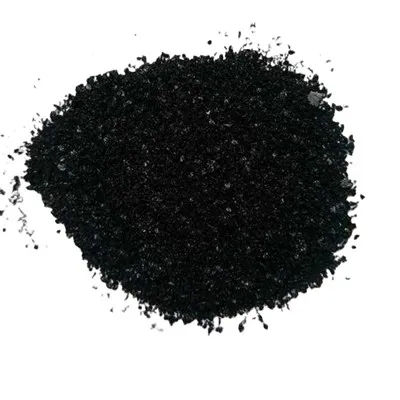
Why Excessively High Temperature in Sulfuration Reaction Causes Product Degradation
Leave a message
Sulfuration is a controllable process involving organic addition and condensation reactions in the production of sulfur black. Reaction temperature serves as a critical parameter determining the molecular structure and stability of the final product. Exceeding the optimal temperature range triggers a series of side reactions that destroy the dye structure, ultimately resulting in product degradation. The detailed mechanisms are as follows:


Sulfur black dye molecules contain numerous chemical bonds including C–S, S–S, and C–C bonds with limited bond energy, which are prone to cleavage at high temperatures. Excessively high temperatures cause the macromolecular chromophores to decompose into small molecular fragments, reducing the content of effective dye components and coloring ability, and significantly deteriorating product strength and shade.
High temperatures drastically accelerate the reaction rate, leading to excessive incorporation of sulfur atoms into the molecular framework to form products with excessive branched chains, uneven crosslinking density, and irregular structures. Such products exhibit poor solubility and weak dyeing performance, failing to form a stable black system, characterized by slow dye uptake, poor leveling property, and darker or reddish shade.
Trace oxygen or air remaining in the reaction system accelerates oxidation reactions at high temperatures, oxidizing part of the sulfides and dye intermediates into by-products such as sulfates and sulfur oxides without coloring capacity, directly reducing the purity and yield of the dye.
Excessively high temperatures tend to cause local overheating, leading to carbonization and coking of materials, generating tar-like substances and coke particles. These impurities are insoluble in water and difficult to filter, affecting not only the appearance and fineness of the product but also causing fabric defects and screen clogging during dyeing, thus reducing application performance.
Small molecular fragments and heterocyclic structures generated by high-temperature cleavage and side reactions tend to detach and migrate after dyeing, resulting in an overall decline in the product's wet rubbing fastness, washing fastness, and light fastness, failing to meet application standards.